Defects Registry

Developers and main contractors

Every unit hands over with a list. This closes it, and keeps the proof.

Defect intake across a whole development, routed to the trade that actually fixes it, closed by a homeowner who signs off in the app — and a timestamped record of all of it that you can produce two years later.

Read this first

What we are, and what we are not.

The short version, before anything else on this page.

What we are

A place where a homeowner records a defect with a photo and a date, and where the fix is recorded with a photo and a date. For you, that is intake tooling and an evidence trail — the record of what was reported and what was done about it, held somewhere neither side can change after the fact.

What we are not

We do not assess construction quality. We do not inspect, sample or certify workmanship, and we do not hold ourselves out as competent to. We publish no assessment of a developer or a main contractor of any kind.

We publish no grade for developers or main contractors. Not now, and not later. This is a decision, not a threshold you can reach. Your subcontractors change from development to development, so a company-level grade would attribute one project’s work to an entity that did not do it and will not do the next one. We are not willing to publish a number we know to be attributed wrongly.

Developments are listed so a homeowner can find their own and log their own defects — a directory, not a scoreboard. There is no ranking of developments, no league table, and no letter beside anyone’s name.

Why be in it

A rectification record is a defence as much as an exposure.

The record cuts both ways, and today it mostly cuts against you — because the only version that exists is the buyer’s.

Proof you fixed it, and when

A defect closed in nine days is nine days on the record, with the photo attached. Right now that fact lives in a site WhatsApp group and evaporates. When it is disputed later, the timestamp is the whole argument.

Proof of what was still open at sign-off

The homeowner signs off in the app, and the record states the date and exactly which items were open at that moment. Everything raised after it is visibly a new list.

One channel instead of five

Not a phone call to the site office, a form on a portal, an email to the agent and a message to the QS. One intake, per unit, that everyone can see the state of.

The one external fact worth knowing

Under URA’s framework for the enhanced protection of home buyers’ interests, effective 22 May 2026, “time taken for rectification” is one of the criteria in scope. It is a real assessment criterion, and nothing publicly published measures it.

We are not that framework and we have no part in it. But if how long rectification takes is going to matter, the party that can show its own timestamps is in a better position than the party that cannot.

URA Circular COH 26-01 →

The tool

Built for four hundred units, not for one.

The homeowner side of this already exists and is free. This is the other end of it.

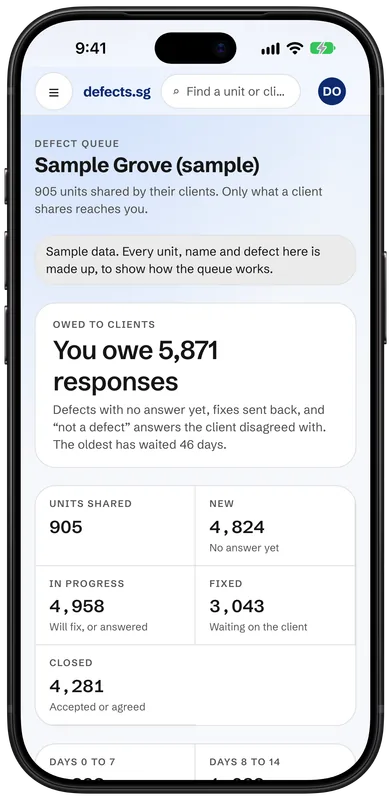
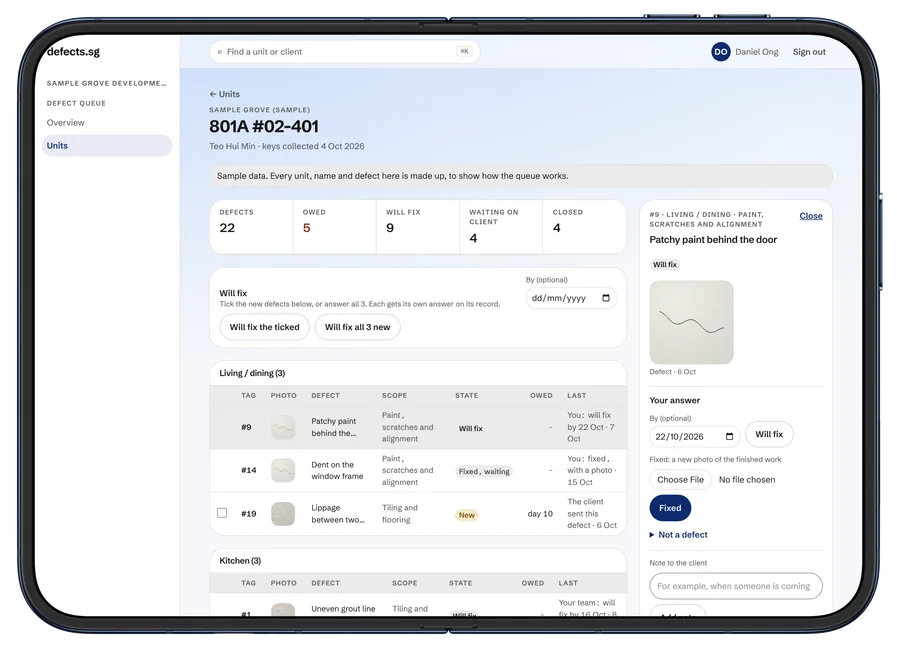
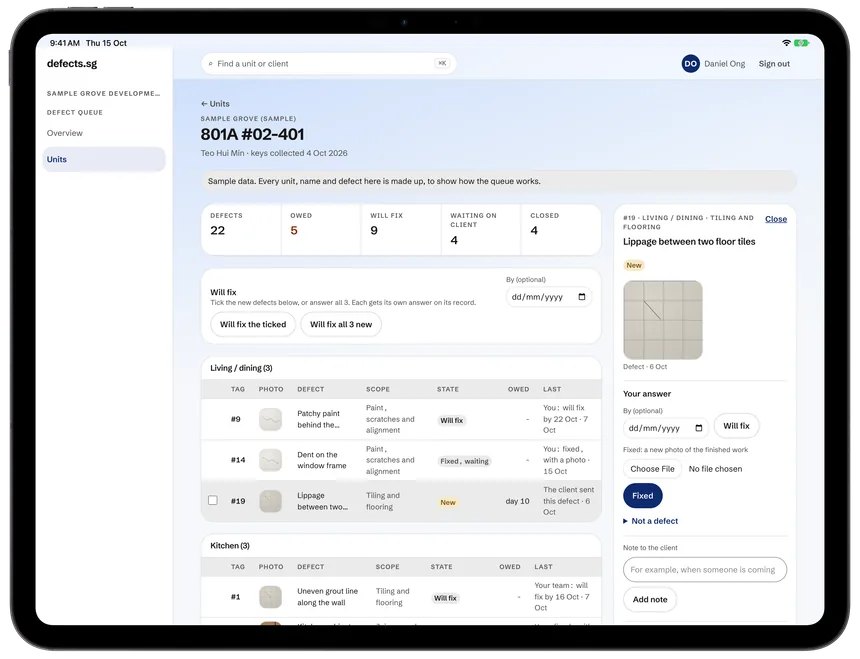
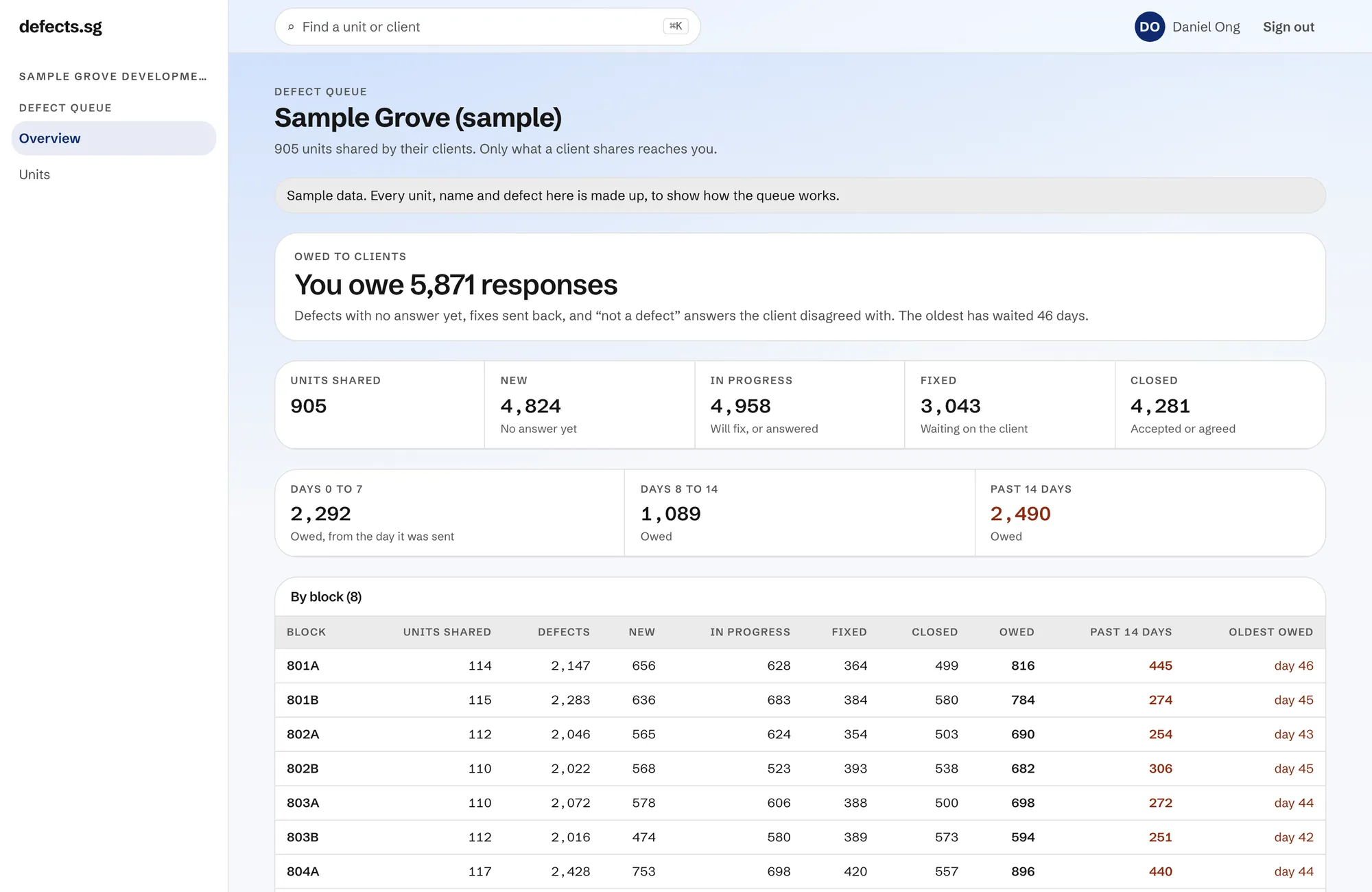
Bulk intake across every unit

Every list from every unit in one queue, filterable by block, by trade and by age. Not four hundred separate email threads.

Route by trade to whoever is fixing it

Tiling to the tiler, joinery to the joiner, with the photos attached and a per-scope sheet they can carry. The subcontractor never needs an account of their own.

A homeowner who signs off, digitally

With a record of the date and what was still open. Chasing a physical form around a handover is the slowest part of the job and it produces the weakest evidence.

Whether a fix counts as accepted is the homeowner’s call, always. You mark it done and attach the proof; they accept it, send it back, or agree to settle it with you. That asymmetry is deliberate — it is the reason the record is worth anything to anyone reading it, including you.

Pricing

Per unit, with a floor. Quoted for the licence.

No enterprise tier and no negotiated exception — the published number is the number.

Main contractor

From launch

S$8per unit

Minimum S$1,500 per development. Bulk intake, trade routing, homeowner digital sign-off, and a printable record of all of it.

Developer licence

From launch

S$3,000–8,000per development

By unit count, quoted. Everything above, across every unit in the development.

A development appears in the registry whether or not anyone pays. Paying buys the tooling and the record — it never buys what is published about a development, because there is nothing there that money could buy. No grade, no ranking, no favourable placement, and no removal.

Marked from launch because developer and main-contractor billing is not open yet. See pricing →

Independence

What we refuse to sell.

  • We never publish a grade, score or ranking for a developer or a main contractor.
  • We never sell placement, and there is nothing about a development that money can change.
  • We never let anyone edit or delete what a homeowner wrote — you included, us included.
  • We never charge a homeowner anything, so a homeowner is never leaned on to close a list.

How we make money →

Questions

The ones your counsel will ask.

Do developers and main contractors get a public grade?
No. We publish no grade and no score for developers or main contractors. Subcontractors change from project to project, so a company-level grade would attribute work to an entity that didn’t do it and won’t do the next one. What we keep is the evidence trail on each development.
What does paying actually buy us?
The tooling and the record: bulk intake across every unit, routing by trade, and a homeowner sign-off you can print and produce later. A development appears in the registry whether or not anyone pays — paying never changes what is published about it.
What happens if we stop paying?
You lose the tooling and can no longer bring new developments into it. Nothing published changes: a development does not come off the registry, and there was never a grade or a score there to remove.
What if a homeowner logs something unfair?
You can respond on any defect — the homeowner sees your response, the public never does. You can never edit or delete what they wrote, and neither can we; if something is factually wrong, write to us. Nothing a homeowner logs produces a score or a grade for you: it produces a record of what was reported and what was done about it.
Who can see a homeowner’s address?
Only their appointed designer or defect checker, while the project is running. Never public, and never on anything a firm can print.
Do you sell our data?
No. We don’t sell leads and we don’t sell contact lists.
Do homeowners pay anything?
No. Not now, not later. Design firms pay to be listed and graded, and other businesses pay for the tooling. Homeowners never pay us anything.
How do we pay?
Invoice and bank transfer. No card required.

Worth reading before your next handover.

The tooling matters the week before keys go out, not the month after. Developer and main-contractor accounts open from launch — the pricing is published now so there is nothing to find out later.